Clean Irrigation Water.
Healthy Crops.
No Conventional Chlorine.
CHLOREX is the 0.75% chlorine dioxide solution that eliminates fungi, bacteria and viruses in irrigation water before they reach the crop. Protect your farm at the source, with no additional machinery and no residues.
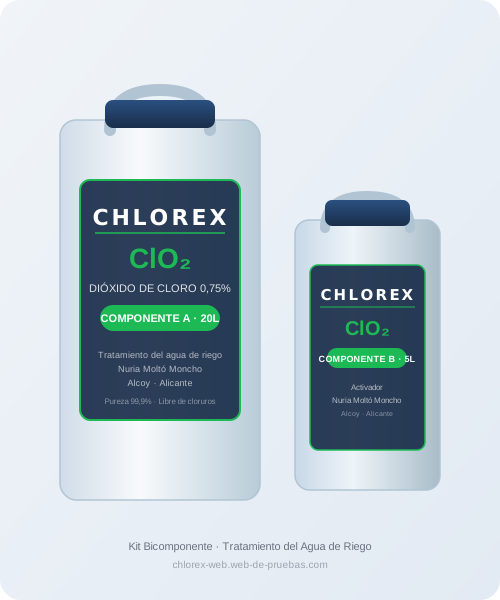
CHLOREX — Two-Component Kit
High-purity (99.9%) 0.75% chlorine dioxide (ClO₂) oxidising solution for the professional treatment of agricultural irrigation water. Supplied as two components for on-site activation — maximum efficacy at the moment of application.
| ClO₂ concentration | 0.75% guaranteed |
|---|---|
| Purity | 99.9% — Free of chlorides and chlorates |
| Shelf life once activated | 30–40 days under optimal conditions |
| Component stability | 3 years in original packaging |
| Available sizes | 5L · 10L · 15L · 20L |
| Distributed by | Nuria Moltó Moncho — Alcoy (Alicante) |
Irrigation water can be a source of infection
Water from ponds, wells, canals and recirculation systems carries pathogens that reach your crops directly through irrigation. Studies in the Mediterranean basin detect Pythium, Phytophthora and Fusarium in more than 60% of the samples analysed.
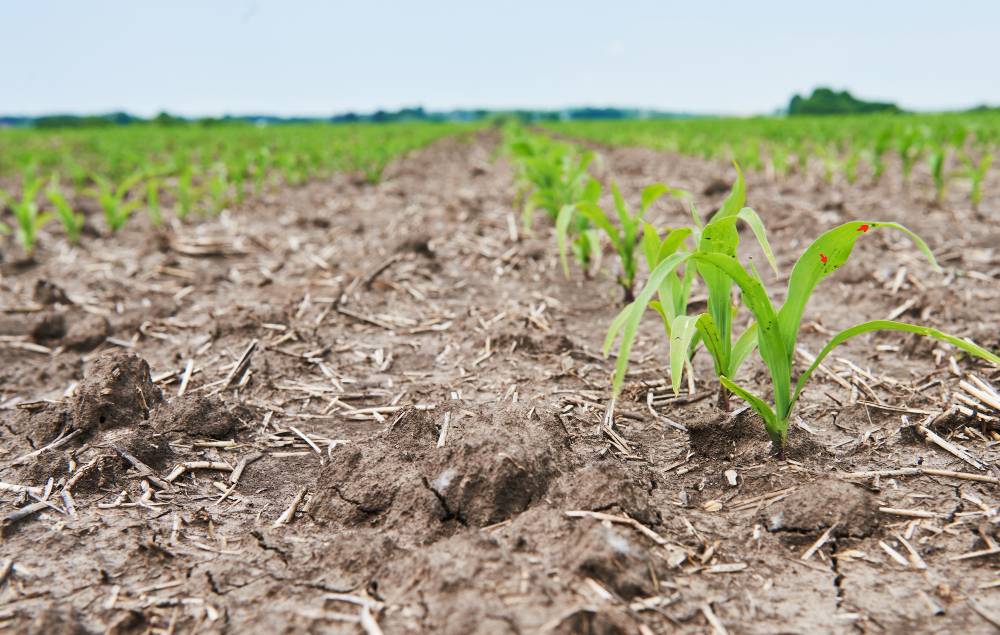
Fungi: Fusarium and Pythium
Their zoospores and spores travel in irrigation water and colonise the roots. They cause root rot, vascular wilt and seedling death within a few days.
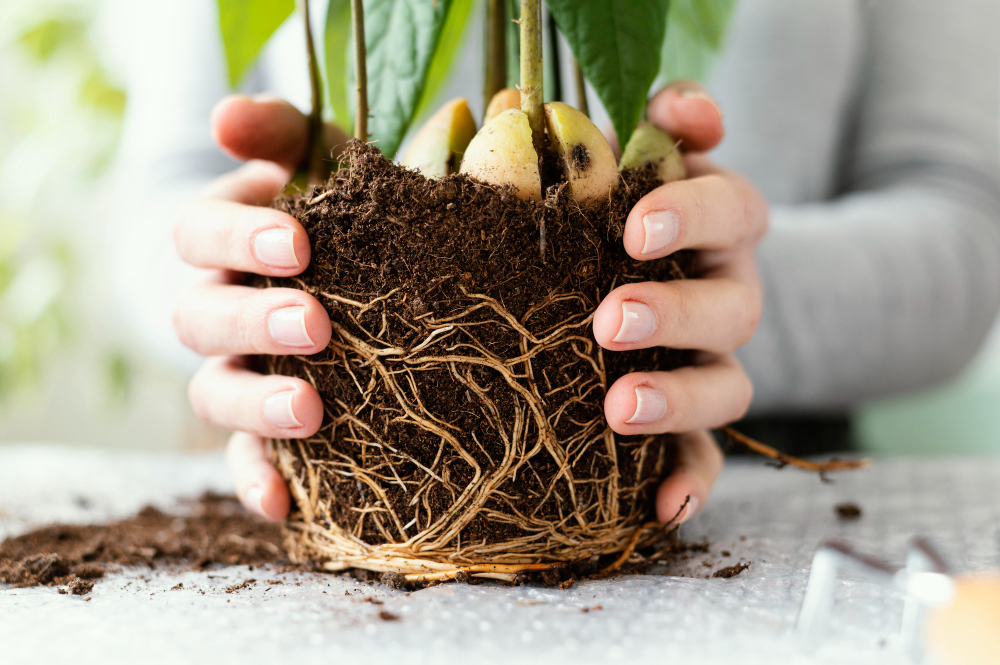
Juvenile nematodes (J2)
Infective nematode juveniles disperse in irrigation water and attack the roots, forming galls that reduce yield by up to 80%.
Transmissible bacteria and viruses
Ralstonia, Erwinia and mosaic viruses are efficiently transmitted by water, contaminating soil and crop from the very first irrigation.
Biofilm in pipes and drippers
Biofilm build-up clogs drippers, reduces flow and becomes a permanent source of contamination in your irrigation system.
Why is chlorine dioxide more effective than conventional chlorine?
Conventional chlorine / Hypochlorite
- Loses efficacy at pH > 7.5 (common in irrigation water)
- Generates toxic trihalomethanes and chloramines
- Corrosive to equipment and metal pipes
- Reacts with organic matter, reducing its action
- Does not remove established biofilm
- Residual odour and taste in the water
CHLOREX — Chlorine Dioxide
- Effective across the whole pH range (2 to 10)
- Generates no toxic by-products
- Compatible with HDPE, PVC and stainless steel
- Does not react with ammonia or ammonium salts
- Penetrates and dissolves biofilm in pipes
- No chlorine taste or odour
No Resistance Development
The oxidative mechanism of ClO₂ prevents microorganisms from developing resistance.
No Phytotoxicity
At the recommended doses, it does not harm plants or crops. Compatible with fertigation.
99.9% ClO₂ Purity
Free of chlorides, chlorates, chloramines and haloacetic acids.
More Economical
Lower dose than traditional chlorine. Continuous application at low concentration.
Removes Biofilm
Penetrates and dissolves the biological matrix that builds up in pipes and drippers.
3-Year Stability
Components stable for 3 years. Activated: 0.75% ClO₂ guaranteed for 30–40 days.
Protocols by water type and use
Continuous Irrigation Water Treatment
Continuous dosing to keep water free of pathogens throughout the crop cycle. Applied via Venturi injector or dosing pump.
40–65 ml/m³ · 0.3–0.45 ppm ClO₂Shock Treatment
One-off high dose to clean pipes, remove established biofilm and disinfect the irrigation network between seasons.
3–5 ppm ClO₂ · 30 minutesPond and Tank Disinfection
Treatment of stored water before distribution. Eliminates pathogens, algae and suspended organic matter.
1–2 ppm ClO₂ · Renew weeklySeedbed Treatment
Disinfection of irrigation water in seedbeds and trays to prevent damping-off caused by Pythium and Rhizoctonia.
0.3–0.5 ppm ClO₂ · ContinuousProduct Technical Data
| Parameter | CHLOREX (A) | CHLOREX (B) | CHLOREX Activated |
|---|---|---|---|
| Appearance | Colourless or yellowish liquid | Colourless or yellowish liquid | Yellowish liquid |
| Density | 1.016 ± 0.100 g/ml | 1.062 ± 0.100 g/ml | 1.025 ± 0.100 g/ml |
| pH | 11.5 ± 0.5 | 0.5 ± 0.5 | 1.5 ± 0.5 |
| Solubility | Soluble in water | Soluble in water | Soluble in water |
| ClO₂ content | — | — | 0.75% guaranteed (30–40 days) |
| ClO₂ purity | — | — | 99.9% — No free chlorine or chlorides |
| Stability | 3 years in original packaging | 3 years in original packaging | 30–40 days from activation |
We answer your questions
CHLOREX eliminates fungi (Fusarium, Pythium, Phytophthora), bacteria (Ralstonia, Erwinia, E. coli), waterborne viruses and infective forms of nematodes (J2 juveniles). Its oxidative action is broad-spectrum.
Yes, it is compatible with drip and micro-sprinkler systems. It requires a Venturi injector or dosing pump. Pipes and components in contact with it must be HDPE, PVC or 316 stainless steel. It is not compatible with soft metals (copper, iron, zinc).
At the recommended doses (0.3–0.45 ppm), the effect on water pH is minimal. CHLOREX remains effective across the pH range typical of irrigation water (6 to 8.5).
Yes. Unlike conventional chlorine, ClO₂ penetrates the extracellular matrix of the biofilm and dissolves it. We recommend an initial shock treatment at 3–5 ppm for 30 minutes to remove accumulated biofilm.
Yes. It is effective in well, pond, canal, recirculated and mains water. Organic matter slightly reduces its efficacy, so pre-filtration is recommended for very turbid water.
CHLOREX is 100% biodegradable and has no cumulative effect. At application doses it leaves no detectable residues on fruit. Always follow the instructions on the technical data sheet.
Ready to protect your crops
starting with the irrigation water?
Join the professional growers who already trust CHLOREX to keep their irrigation water free of pathogens without compromising crop health or the environment.